More on More-than-human
A Yawning Fox Press Think-Piece
By Sydney Trauba
adjective.
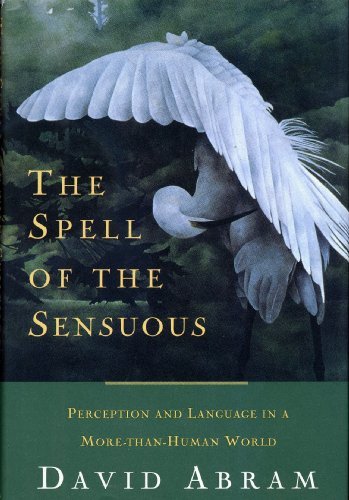
The phrase was intended, first and foremost, to indicate that the realm of humankind (with our culture and technology) is a subset within a larger set—that the human world is necessarily embedded within, permeated by, and indeed dependent upon the more-than-human world that exceeds it. Yet by this new phrase I also meant to encourage a new humility on the part of humankind, since the ‘more’ could be taken not just in a quantitative but also in a qualitative sense.
~ ~ ~ ~ ~ ~
Art and writing are often understood as uniquely human achievements—living proof of human creativity and singular capabilities. Yet this perspective unintentionally reinforces the idea that the world begins and ends with us. David Abram coined the phrase “more-than-human” to challenge that assumption; to embrace the notion that humanity exists within, rather than apart from, a larger living world. This invites reconsideration not only of humanity’s relationship with nature, but also of the way we understand creativity.
Abram emphasizes humility and its significance for creative work.1 Within contemporary culture, the artist is often celebrated as an individual genius whose value lies in producing something entirely new. This obscures the fact that every act of creation depends on forms of knowledge, sustenance, and inspiration that operate before and beyond the artistic self. Even language itself is rooted in encounters with the physical world. Rather than treating the world as raw material waiting to be interpreted, we might approach it as a community of presences worthy of attention in their own right.
The soil has a story which it tells every day to those who listen to its quiet voice. Gales, on the other hand, are boisterous, travelling far and wide and generating tales of grandeur. Even the little field mouse who has only known one farm has its day-to-day dramas. A forest offers a symphony of voices and perspectives. Our task is to live within this complex array and to understand the more-than-human world from within.
Art, then, becomes an act of listening as much as an act of expression.
Sustained attentiveness to the “more-than-human” world fosters a greater sense of belonging. Rather than experiencing ourselves as detached observers, we begin to understand that our lives unfold within a network of reciprocal relationships. As our egocentric model shifts to an ecocentric one, it becomes more difficult to exploit or ignore the marvelous beings that surround us.
Looking deeply at the moth, the bee, or the grasshopper, we can enter into their brief, fragile worlds. In another moment we may be struck by the resemblance between human blood and sap dripping down the trunk of an ancient tree. A grass stain becomes the symbol of a very good day, not a bothersome mark to be cleaned away, and a human can’t hold back the yawn that stretches their jaw and cools their mind in the presence of a yawning fox.
Creativity is not just a means of expressing ideas; it is a practice of cultivating care. Through art, we learn not only to represent the world but to recognize and articulate our responsibility to it. Water the garden, snip the dead buds, be kind to the earthworms—this connection, this understanding, is the basis of meaningful art.
At Yawning Fox Press, we celebrate that relationship, we give credit where credit is due, and we approach the “more-than-human” world with an abiding and humble curiosity. We invite writers and readers—people—to join us in exploring this marvelous world and the beings who share it with us.